
RETURN OF EARNINGS: COMPLIANCE MISTAKES SOUTH AFRICAN EMPLOYERS MUST AVOID
RETURN OF EARNINGS: COMPLIANCE MISTAKES SOUTH AFRICAN EMPLOYERS MUST AVOID

Picture this: It's the end of June, and your finance team is focused on month-end responsibilities while juggling multiple compliance deadlines.
You assume your annual Compensation Fund Return of Earnings (ROE) is under control because you've submitted it every year before.
Then an urgent tender opportunity arises, or a client requests your Letter of Good Standing, only to discover that an outstanding ROE submission or assessment has left your business non-compliant.
This scenario is more common than many South African businesses realise. Small errors in ROE submissions––such as under declaring earnings, misclassifying overtime or missing deadlines––can trigger audits, fines and exposure during inspections.
In a previous article we discussed how Return of Earnings should be submitted. To support compliance with the Compensation for Occupational Injuries and Diseases Act (COIDA), this blog outlines five common ROE mistakes employers should avoid.
5 Key Return of Earnings mistakes South African businesses should avoid
Based on the requirements of the Compensation for Occupational Injuries and Diseases Act (COIDA) and the guidelines of the Department of Employment and Labour, the following are the top five ROE mistakes South African businesses should avoid to ensure full compliance and prevent penalties:
1. Incorrect earnings declarations (overtime mistakes)
According to COIDA guidelines, employers must ensure "overtime of a regular nature" is included in the earnings declaration. Irregular or once-off overtime is generally excluded.
2. Failing to declare the correct number of employees
Failure to accurately declare the employee count (including casual and fixed-term workers), their earnings and directors receiving remuneration, could be considered under-declaration. If earnings are under-declared, a penalty may be imposed of up to 10% of the difference between the earnings on the ROE and the actual amounts earned. Failure to provide a credible explanation for a 50% variance (where there are significant changes in staff or salaries from the previous year) can trigger system flags and result in audits that may take months to finalise.
3. Failing to report business changes (within 7 days)
If your business changes its address of sector, or ceases to operate, you must notify the Compensation Fund within 7 (seven) days. Failure to update or submit a CF-1C deregistration form if the business closes, the employer may still be treated as active, which could result in unnecessary assessments.
Misclassifying industry / risk rating
Failure to ensure that your business is categorized under the correct industry classification can result in an incorrect assessment rate, leading to higher assessments.
Missed deadlines and unpaid assessments
ROE’s submitted after the due date will incur a 10% penalty added to the assessment amount. Failure to settle the assessment amount within 30 days will result in a 10% late payment penalty, with interest accruing monthly on overdue amounts.
Key 2025 update: Maximum annual earnings for ROE submissions
The maximum annual earnings per employee for ROE assessment purposes is R633 168 (effective 1 March 2025). It is therefore crucial for accurate ROE submissions to safeguard employees, ensure compliance, and reflect responsible business practice.
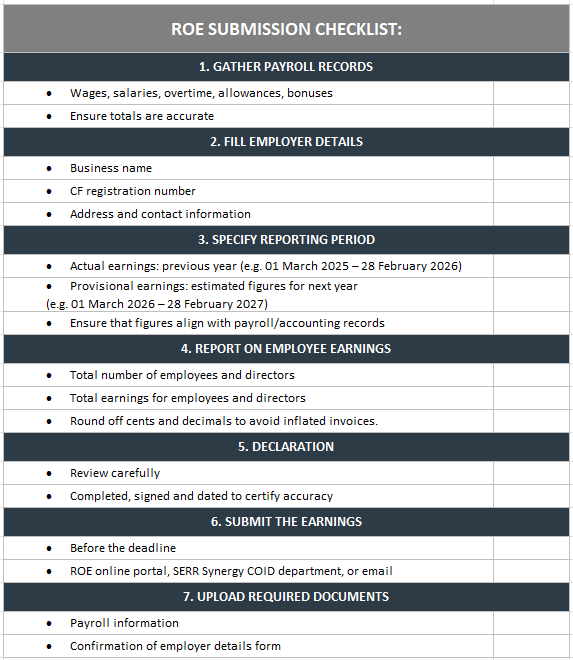
The following checklist provides practical guidance to help South African businesses avoid common ROE submission errors and ensure compliance.
Conclusion
ROE compliance is like maintaining a car: skipping small checks today can lead to costly breakdown tomorrow. An incorrect declaration, unpaid assessments or missed deadlines, will have a financial implication on the employer which could be more challenging to obtain a LOGS if these checks are overlooked. By avoiding these five common mistakes, you not only protect your business from unnecessary fines but also strengthen your credibility with the Compensation Fund. Compliance is not just about ticking boxes — it is about safeguarding your employees, your reputation, and your ability to operate smoothly within South Africa’s regulatory environment.
Before the next ROE deadline arrives, take the time to review your processes, double-check your declarations, and ensure that all details are up to date. A little diligence now can prevent significant challenges later.
As part of our value-added Occupational Health and Safety (OHS) services, SERR Synergy's COID practitioners assist employers with accurate Return of Earnings (ROE) submissions, discrepancy audits, industry classification reviews, and obtaining valid Letters of Good Standing. Proactive compliance today helps prevent costly corrections tomorrow.
About the Author: Mandy Beckley is a quality assurance leader at SERR Synergy, heading the OHS Department’s Development Hub. Since 2017, she has strengthened the documentation system with precision and high standards. With ISO 9001:2015 certification and extensive administrative experience, Mandy ensures compliance, consistency, and excellence across the OHS Management System. Where detail meets integrity: ensuring quality that people can count on.


